


When you ask the question, “When was the pilgrimage of Hajj made obligatory (farz) in Islam?”, you are not only searching for a date in history. You are trying to understand one of the most important turning points in Islamic life.
Hajj is more than a journey to Mecca; it is a duty that completes your faith once you have the means to perform it. Knowing when it became farz helps you see how this sacred act grew from a practice of the prophets before Islam into one of the main pillars of your religion.
This question matters deeply for every Muslim because Hajj connects you to the story of faith, obedience, and unity. It reminds you of the Prophet Muhammad’s mission and how the message of Islam evolved. Understanding when made Hajj was made compulsory gives you insight into how Islamic rulings were revealed with wisdom, based on timing, strength, and the readiness of the Muslim Ummah.
Scholars, however, have shared different views about the exact year when Hajj became farz. Some say it was in the 5th or 6th year after Hijra, while most agree it was made obligatory in the 9th year of Hijra. These differences come from variations in early narrations, interpretations of Quranic verses like Surah Al Imran 3:97, and the historical timeline of the Prophet’s actions.
In this post, you will explore the full background of how and when Hajj became an obligation. You will learn about the historical events that led to it, the Quranic and Hadith evidence that confirm it, and why different scholars give slightly different years.
You will also understand the spiritual and practical importance of that moment in Islamic history and what it means for you today as a believer who seeks Hajj Packages to fulfill this pillar with sincerity, like Umrah.
What is Hajj and What Does “Farz” Mean?
Hajj is the sacred pilgrimage to the holy Ka‘bah in Mecca, a journey that every able Muslim must perform at least once in life. It is one of the five main pillars of Islam and represents complete submission to Allah.
During Hajj, you follow the footsteps of Prophet Ibrahim, Hajar, and Prophet Muhammad by performing specific rituals that express obedience, sacrifice, and unity. Every action in Hajj—from wearing Ihram to standing at Arafat—has deep spiritual meaning and connects you to the long chain of faith that began thousands of years ago.
The word “Farz” or “Fard” in Islamic law means an act that is made compulsory by Allah. When something is farz, it is not optional or based on personal choice; it becomes a clear command in the Shariah. Performing what is farz earns you a reward, and neglecting it without a valid reason brings sin.
Hajj is one of those farz duties, just like Salah, fasting in Ramadan, and giving Zakat. Understanding this word helps you see that Hajj is not just a spiritual wish—it is a legal and moral obligation for every qualified believer.
However, the obligation of Hajj depends on your ability. You are only required to perform it if you have both physical and financial strength. This means you must be healthy enough to travel and perform the rituals, and you must have enough money to cover your journey and take care of your dependents while you are away.
If you do not have the means, the duty does not apply until you do. This condition reflects the balance and mercy within Islam—it ensures that your worship is based on both faith and fairness. When you finally gain the ability, fulfilling Hajj becomes your responsibility and a sign of your gratitude to Allah for giving you the means to obey His command.
Historical Background: Before the Obligation
In the early period of Islam, after the Prophet Muhammad migrated from Mecca to Medina, known as the Hijra, the Muslim community began to form its identity. This migration was not just a move from one city to another; it marked the beginning of a new stage in Islamic history. In Medina, the Prophet established the first Islamic society based on justice, unity, and faith. It was here that many Islamic laws and duties were revealed, including the rulings for prayer, fasting, and later, the obligation of Hajj. The community grew stronger both in number and faith, preparing for the time when they could return to Mecca freely to worship Allah without fear or restriction.
Before the conquest of Mecca, the situation around the Ka‘bah was very different. Although it was originally built by Prophet Ibrahim and his son Ismail as a house for the worship of one God, over time, the people of Mecca filled it with idols. They turned the Ka‘bah into a center of polytheism, performing rituals for many false gods. This period represented spiritual corruption and the loss of pure monotheism.
For Muslims in Medina, seeing their holy sanctuary taken over by idol worshippers was painful, but they had to wait until Allah granted them victory. Only after the conquest of Mecca in the 8th year of Hijra was the Ka‘bah cleansed, and worship returned to its original purpose—the worship of Allah alone.
The verse from the Quran, Surah Al Imran 3:97, holds great meaning in this history. Allah says, “Hajj to the House is a duty that mankind owes to Allah, for those who are able to find a way there.” This verse clearly defines Hajj as an obligation for those who can perform it. The timing of this revelation came after the Muslims gained control of Mecca, making the pilgrimage both possible and safe again. It reflects the wisdom in the sequence of Islamic rulings—Hajj was made farz only when the Muslims were strong enough to perform it.
According to Islam-QA and many scholars, this verse confirms that Hajj became obligatory around the 9th year of Hijra, when the command could finally be fulfilled without fear or barrier. This moment linked faith, history, and victory, showing that every ruling in Islam came with purpose and perfect timing.
When Did Hajj Become Obligatory? Scholarly Views
Some scholars believe that Hajj became farz in the 5th year after Hijra. According to sources such as Fiqh Islam Online, this view is based on early narrations that suggest the command for Hajj might have been revealed soon after the obligation of fasting and Zakat. The reasoning is that by 5 AH, Muslims had already established many parts of their religious system, and Medina was stable enough for new obligations to be introduced.
However, this view has limited direct evidence from authentic Hadith. It is mainly supported by interpretation and timeline analysis rather than clear text from the Quran or Sunnah.
Another group of scholars places the obligation in the 6th year after Hijra. As explained by About Islam, this view connects the ruling to the time around the Treaty of Hudaybiyyah. In that year, the Prophet Muhammad and his companions set out for Umrah but were stopped by the Quraysh.
Some scholars suggest that the intention to perform Hajj or Umrah at that time may indicate that the obligation was already known or about to be revealed. Still, this opinion is not widely supported because the Muslims did not yet have access to Mecca, which would make it difficult to fulfill the command of Hajj fully.
The majority of scholars, including those referenced by Islam-QA, agree that Hajj became farz in the 9th year after Hijra. This year is also known as the Year of Delegations, when many tribes came to Islam after the conquest of Mecca. The verse in Surah Al Imran 3:97 was revealed during this time, clearly commanding believers to perform Hajj if they were able. The political and social conditions also support this timeline.
By 9 AH, Mecca was under Muslim control, idol worship had been removed, and the road for pilgrimage was open and safe. The Prophet himself performed his first and only Hajj in the 10th year after Hijra, which shows that the obligation was already in place before that time.
The difference in these views mainly comes from how scholars interpret the order of revelation and historical events. Some use indirect signs, such as the Prophet’s actions or earlier intentions, while others rely strictly on Quranic verses and authenticated narrations. The 9 AH view stands out because it fits both the Quranic evidence and the historical situation.
Before that year, the conditions for Hajj—especially safety and access to Mecca—were not yet met. Islam teaches that obligations come only when they are possible to perform, and that aligns perfectly with the timing of 9 AH.
Based on available evidence and scholarly agreement, the most probable conclusion is that Hajj became farz in the 9th year after Hijra. Still, it is important to acknowledge that earlier opinions exist and are part of Islamic scholarly discussion. Recognizing these differences helps you understand that Islamic knowledge is built on deep study, not guesswork. While you can accept 9 AH as the strongest view, knowing the other opinions gives you a more complete and respectful understanding of how Islamic rulings developed over time.
Evidence and Reasons Supporting the Obligation in 9 AH
The ninth year after Hijra is known in Islamic history as the Year of Delegations, or ‘Aam al-Wufud’. During this year, many Arab tribes from different regions of the Arabian Peninsula came to meet the Prophet Muhammad in Medina. They came to declare their acceptance of Islam, seek knowledge, and pledge loyalty to the Muslim state.
This period marked the spread of Islam beyond local tribes and the completion of the Prophet’s mission to deliver the message of Allah to all people. It was a time of peace, unity, and growth for the Muslim Ummah, as old barriers were removed and the call to worship one God became widespread. The Year of Delegations was also a sign that the Islamic faith had matured enough for new religious obligations like Hajj to be fully practiced.
According to Islam-QA, the command for Hajj was revealed during this same year through the verse in Surah Al Imran 3:97. In this verse, Allah says that performing Hajj to the House is a duty owed to Him by every person who has the means to reach it. This revelation carried great importance. It came after the Muslims had achieved victory in Mecca and could safely perform pilgrimage without interference.
The timing shows Allah’s perfect wisdom, as the command was given only when the conditions for obedience were ready. Scholars also mention that this verse linked the ancient worship of Prophet Ibrahim to the renewed call of Islam, making Hajj a symbol of both faith and continuity.
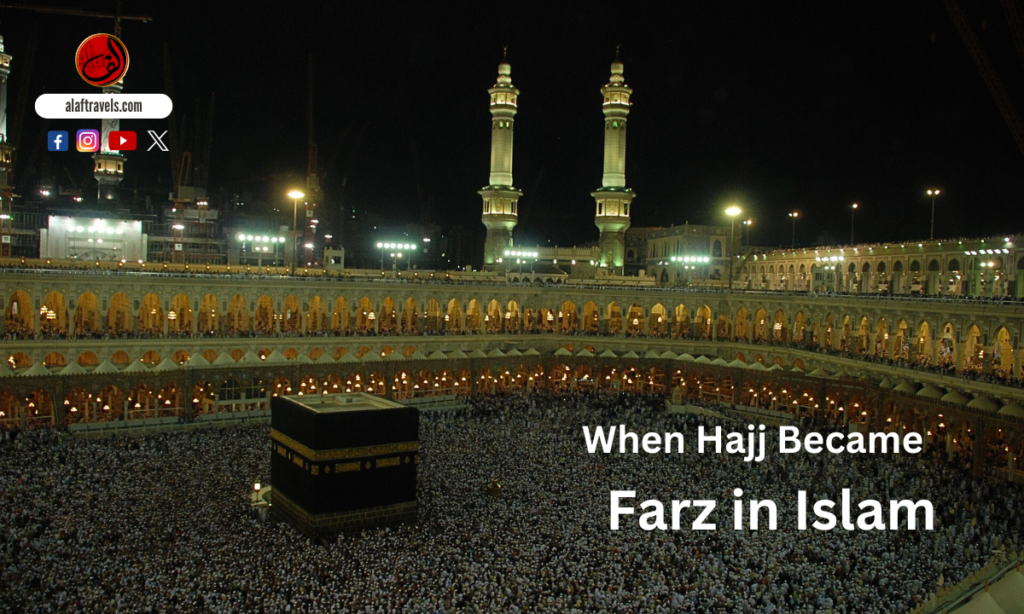
The conquest of Mecca in 630 CE, or the 8th year after Hijra, played a major role in this process. Before that victory, the Ka‘bah was still filled with idols, and Muslims had no access to perform Hajj freely. When the Prophet and his companions entered Mecca and cleansed the Ka‘bah of all idols, the city was restored as a pure place of monotheistic worship. From that moment, the road to Mecca became open for Muslims, and the political and spiritual environment was suitable for making Hajj obligatory.
As Islam-QA explains, this sequence of events shows divine wisdom—Allah does not command what is impossible to perform. The ruling of Hajj came only after Mecca was purified and the journey was safe, reflecting Islam’s balance between faith and practicality.
In addition, authentic Hadith reports confirm that the Prophet Muhammad performed his one and only Hajj in the 10th year after Hijra. As mentioned by Islam and Ihsan, this event, known as the Farewell Pilgrimage, proves that the obligation was already in place before that year. The Prophet’s Hajj served as both a practical demonstration and a final sermon to the Ummah, showing them how to perform every ritual correctly.
His decision to perform Hajj a year after the command was revealed also reflects organization and preparation, as large groups of new Muslims were ready to join him. This moment completed the message of Islam, uniting faith, obedience, and practice into one historic act that remains the ultimate symbol of devotion.
Practical Implications of That Date
When Hajj was made an obligation, it became a personal duty for every Muslim who meets the required conditions. Once you have the physical and financial ability to perform Hajj, it becomes farz upon you and cannot be ignored. The obligation means that you are expected to act upon it as soon as possible because it is one of the five pillars that complete your faith.
Hajj is not just a ritual; it is a test of your obedience and gratitude to Allah. Performing it shows your readiness to sacrifice comfort, wealth, and time for the sake of fulfilling a divine command. For Muslims, understanding this obligation also means realizing that Hajj represents equality and unity, where every believer stands before Allah in the same simple clothing, without difference of status or wealth.
Jurists, including scholars such as Ayatollah Sistani, explain that delaying or postponing Hajj without a valid reason is not allowed once the conditions are fulfilled. If you are capable and have the means, you must not delay it unnecessarily because life is uncertain, and no one can guarantee the same opportunity later.
According to Sistani’s rulings, if a person meets the conditions and intentionally delays Hajj until they lose the ability to perform it, they are considered sinful. However, if the delay is due to genuine reasons like health problems, financial instability, or safety issues, it is not counted as neglect. This legal view in Islamic jurisprudence ensures that you perform Hajj responsibly and at the right time, with both intention and preparation.
For you today, the lesson is clear. Understanding when Hajj became farz helps you value its importance and prepare wisely. Knowing its history allows you to see how it evolved from a local practice to a universal act of worship. It also reminds you that performing Hajj is not about rushing; it is about readiness, both spiritual and practical. If you are able, you should plan early—save money, learn the rituals, and strengthen your faith before you go.
For those who cannot yet afford it, learning about Hajj keeps the intention alive until the opportunity comes. The obligation may have been revealed in the 9th year of Hijra, but its meaning remains timeless. It continues to teach every Muslim the value of commitment, unity, and submission to Allah’s will.
FAQs
If Hajj became farz in 9 AH, why did the Prophet perform it in 10 AH only?
When Hajj became farz in the 9th year after Hijrah, the Prophet Muhammad did not perform it immediately because the conditions at that time were not yet suitable for a full and proper pilgrimage.
In 9 AH, many tribes had recently accepted Islam, and some old practices of idol worship were still being cleansed from the region. The Prophet wanted to ensure that the sacred rituals of Hajj were performed in their pure Islamic form, free from any traces of pagan customs.
“Does the exact year matter for my worship today?
The exact year when Hajj became farz does not affect your personal obligation to perform it, but it holds great historical and spiritual value. Knowing whether it was made compulsory in 9 AH or 10 AH helps you understand how Islam developed step by step and how the Prophet guided the ummah with wisdom and care. It shows the timeline of how faith, obedience, and community strength grew before Hajj became a duty.
“What if I cannot afford Hajj?
If you cannot afford Hajj, then the obligation does not apply to you until you are able. In Islam, Allah does not place a burden greater than what you can carry. Hajj becomes farz only when you meet certain conditions, and financial ability is one of the main ones.
This means you must have enough money to cover your travel, accommodation, and basic needs during the journey, as well as leave enough for your family at home while you are away.
“Are there modern rulings about Hajj obligations?
Yes, modern scholars have discussed Hajj obligations in today’s context to help you understand how the rulings apply in modern life. The basic rule remains the same: Hajj is farz once in a lifetime for every Muslim who is physically and financially able.
However, with travel systems, visa processes, and global movement changing over time, scholars have explained how these affect your ability to perform Hajj.
Conclusion
When you look at all the available evidence, the most supported view among scholars is that Hajj became farz in the 9th year after Hijrah (9 AH). Some scholars, however, believe it may have been in 10 AH. Both opinions are based on authentic historical and Quranic references, but most experts agree that 9 AH fits best with the timeline of the Prophet’s final years and the verse in Surah Aal-e-Imran (3:97). It was also the year when Islam had spread across Arabia, and conditions were suitable for all Muslims to perform Hajj safely.
Understanding this part of Islamic history helps you value your faith and duty more deeply. When you know when and how Hajj became obligatory, it connects you with the early Muslim community and their journey of faith. It also reminds you that every command in Islam came at the perfect time — when people were ready to follow it with a full heart and understanding.
If you are financially and physically able, you should start planning your Hajj with sincerity and preparation. If you are not yet able, use this time to learn more about its rituals, meanings, and purpose. Strengthen your intention, study the fiqh of Hajj, and build your spiritual readiness so that when your opportunity comes, you are fully prepared.
You can explore more by reading trusted Islamic sources such as Islam-QA, Fiqh Islam Online, and books of scholars like Imam Nawawi and Ibn Kathir. These resources will help you deepen your understanding of when Hajj became farz and how it continues to guide Muslims toward unity, patience, and devotion.